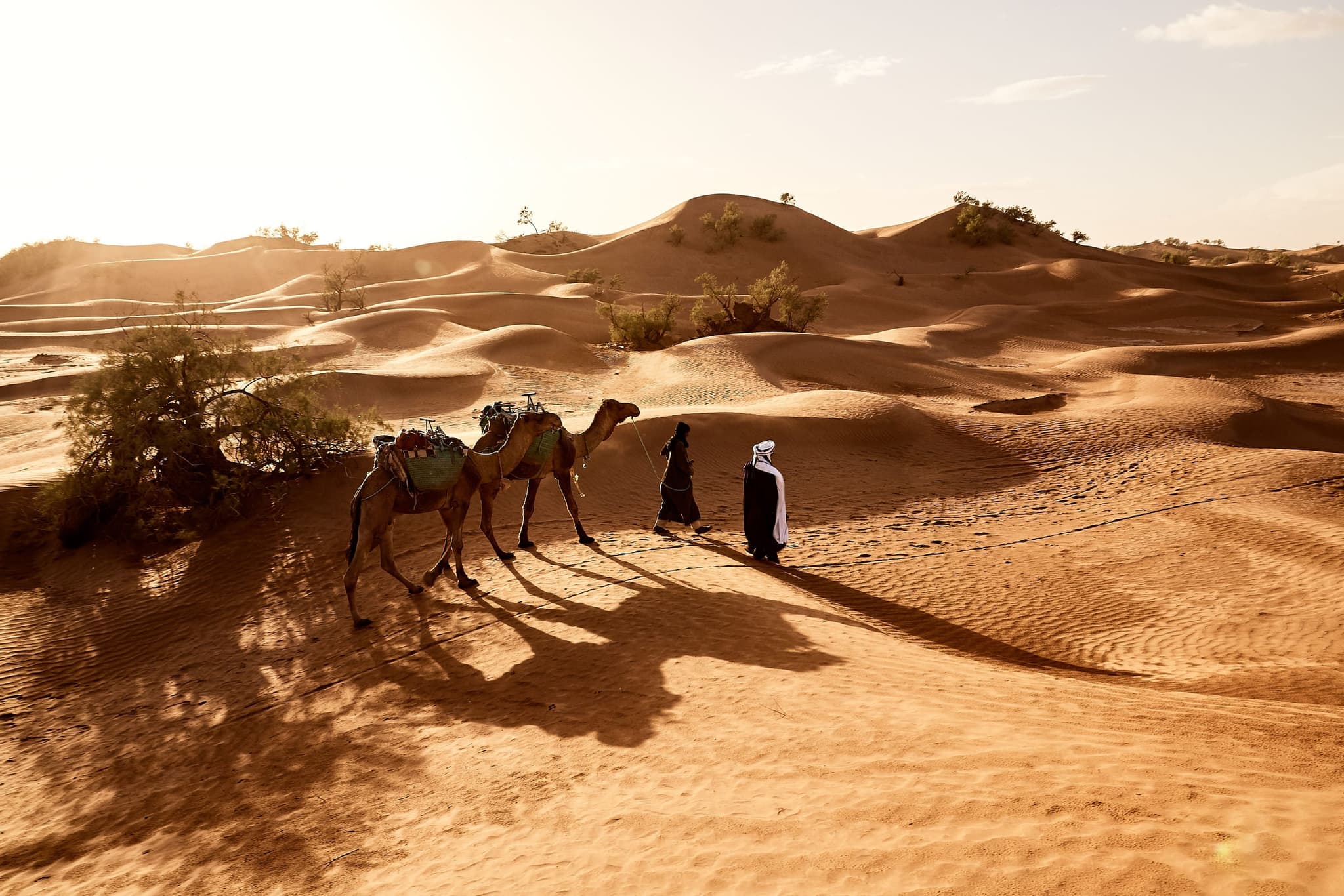
Zagora vs Merzouga: what you trade for four hours
This is the only comparison that matters when choosing a Moroccan desert from Marrakech. Four hours of driving each way, against roughly four times the dune height.
| Zagora | Merzouga (Erg Chebbi) | |
|---|---|---|
| Drive from Marrakech | ~360 km, 6–7 h | ~560 km, 8–10 h |
| Max dune height | ~40 m | ~150 m |
| Dune field scale | Scattered pockets | ~28 km continuous erg |
| Trip length | 2 days works | 3 days needed |
| Group price | €70–120 | €130–200 |
| Camel ride to camp | 30–60 min | 45–90 min |
| Route highlight | Draa Valley palm groves | Ait Ben Haddou, Todra Gorge |
| Crowds | Medium | High |
A useful rule: if the Sahara is one item on a broader Morocco itinerary, Zagora fits without damaging the rest of the trip. If the Sahara is the trip, the extra day for Merzouga is the better spend. The full Merzouga vs Zagora comparison goes deeper on camp quality.
Zagora's strengths and its real limits
Why it’s worth it
- The shortest road to genuine Sahara dunes from Marrakech — 6–7 hours instead of 8–10.
- A real 2-day trip: one night in a camp without losing three days of your itinerary.
- Cheapest desert overnight in Morocco, from around €70 per person.
- The Draa Valley drive is the best part — 200 km of palm groves and mud-brick ksour.
What to know first
- The dunes are small. At roughly 40 m they are a fraction of Erg Chebbi's 150 m.
- Not a continuous erg — Tinfou and Erg Lihoudi are isolated pockets, not a sand sea.
- If you have already seen large dunes anywhere, Zagora will read as underwhelming.
- Some budget operators camp within sight of the road, which undoes the whole point.
The Draa Valley is the better half of the trip
Most Zagora itineraries treat the drive as transit. It is the part travellers remember.
The palm corridor. From Agdz to M’Hamid the Draa runs roughly 200 km through continuous palm groves, irrigation channels, and fortified mud-brick ksour. It is Morocco’s longest river valley and one of the country’s great drives — ask your driver to stop in Agdz rather than pushing straight through.
Tamegroute. Eighteen kilometres south of Zagora, known for two things: green-glazed pottery fired in underground kilns using a technique specific to the village, and the Nasiriyya library, which holds medieval manuscripts including works on mathematics and astronomy.
Amezrou and Jbel Zagora. Amezrou is the old Jewish quarter across the river, still a silver-working centre. Jbel Zagora, the hill above town, gives the full view down the valley — best in the hour before sunset, and a short enough climb to do before dinner.
Free to use · Answers built with 47 licensed local guides
Zagora desert: frequently asked questions
Is Zagora worth visiting, or should you go to Merzouga?
Go to Zagora if you have exactly two days — it is the only Moroccan Sahara gateway that works in that window, at 6–7 hours from Marrakech rather than 8–10. Go to Merzouga if you have three days and the dunes are the reason for the trip; Erg Chebbi's 150 m crests are roughly four times the height of anything near Zagora. Zagora is a good short trip, not a substitute for Erg Chebbi.
How big are the dunes at Zagora?
Small by Saharan standards. The Tinfou dunes about 25 km south of Zagora reach roughly 20–30 m, and Erg Lihoudi near M'Hamid tops out near 40 m. They are isolated pockets rather than a continuous dune field. For comparison, Erg Chebbi at Merzouga reaches about 150 m and runs 28 km. If your mental image is towering ridgelines, Zagora will not deliver it.
How long does it take to drive from Marrakech to Zagora?
About 360 km and 6–7 hours, via the Tizi n'Tichka pass over the High Atlas, then Ouarzazate, Agdz, and down the Draa Valley. Most 2-day tours stop at Ait Ben Haddou on the way. The road is fully paved and in good condition. Winter snow can briefly close the Tichka pass, which adds a long detour via Demnate.
What is there to see in the Draa Valley?
The Draa is Morocco's longest river valley — a 200 km ribbon of palm groves, irrigation channels, and fortified mud-brick ksour between Agdz and M'Hamid. Highlights are Tamegroute, 18 km south of Zagora, known for its distinctive green-glazed pottery and the Nasiriyya library of medieval manuscripts; the Amezrou kasbah quarter with its silver-working tradition; and the climb up Jbel Zagora for the full valley view.
Is a 2-day Zagora desert tour enough?
Yes, more genuinely than a 2-day Merzouga tour is. Zagora at 6–7 hours each way leaves real time in the desert rather than a token stop. You leave Marrakech in the morning, reach the dunes for a late-afternoon camel trek, sleep in a camp, and return the next day. The same 2-day format applied to Merzouga means around 20 hours of driving for one short evening.
What does a Zagora desert tour cost?
A shared 2-day group tour from Marrakech runs €70–120 per person, covering transport, the camel trek, one night in a camp, dinner, and breakfast. Private tours for two to four people are typically €150–250 per person. It is the cheapest way to sleep in Sahara dunes in Morocco. Camps booked directly in Zagora or M'Hamid can be cheaper again if you arrive independently.
What is the "Timbuktu 52 days" sign in Zagora?
A painted road sign on the southern edge of Zagora reading "Tombouctou 52 jours" — a reference to the caravan crossing time to Timbuktu in Mali by camel. Zagora sat on the trans-Saharan trade route, and the sign marks the point where the road effectively ran out and the desert crossing began. It is the town's most photographed landmark, though the current sign is a modern replacement.
Can you reach the Zagora dunes without a 4x4?
Yes. The Tinfou dunes, about 25 km south of Zagora on the M'Hamid road, are visible from and reachable by ordinary car — one of the few Moroccan dune fields you can drive to directly. Erg Lihoudi near M'Hamid needs a short 4x4 or camel leg but nothing like the two-hour off-road run required for Erg Chigaga.